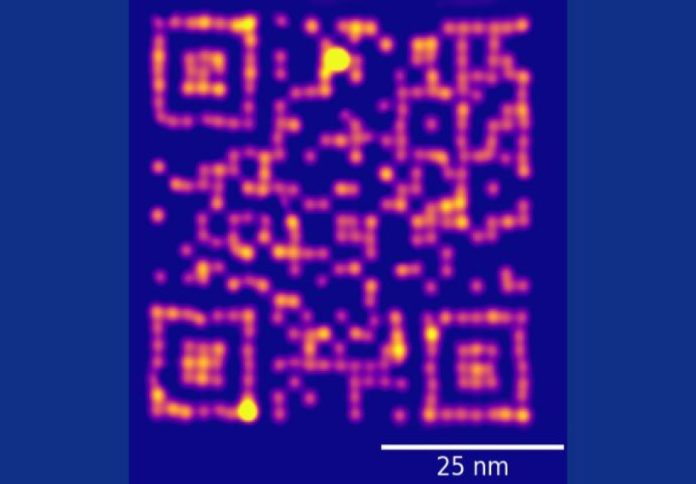
Researchers from Monash University and the Czech Academy of Sciences have created what is believed to be the world’s smallest scannable QR code, constructed atom by atom and measuring just 50 by 50 nanometres.
The code is more than 1,000 times smaller in width than a human hair and almost 800 times smaller in area than the current Guinness World Record holder, according to the university.
The team built the QR code using an ultra-precise scanning tunnelling microscope capable of imaging and manipulating individual atoms under ultra-high vacuum and cryogenic conditions. By positioning silver atoms one at a time on a surface, researchers formed a pattern that can still be read using a standard mobile phone.
“This is a playful demonstration of the extraordinary level of control these microscopes give us at the atomic scale,” said Dr Julian Ceddia from Monash University’s School of Physics and Astronomy.
“But the same techniques are also being used by researchers around the world to build entirely new materials atom by atom, structures that simply don’t exist in nature.”
The work was carried out in collaboration with the Institute of Physics of the Czech Academy of Sciences (FZU) in Prague, where researchers also highlighted the precision required to assemble the structure.
“We very gently brought our probe, coated in silver atoms, into contact with a silver surface,” said Dr Oleksandr Stetsovych. “With the right conditions, we can leave behind a single atom exactly where we want it.”
According to the researchers, much of the construction was automated before final manual adjustments ensured the QR code could be successfully scanned.
“The automation got us most of the way there,” said Dr Benjamin Lowe. “Then we manually adjusted and aligned the final atoms to make the QR code fully scannable.”
Beyond its novelty, the project is also being used to showcase scanning probe microscopy and promote an outreach initiative called “SPM Pro Tips,” which encourages researchers to share and explain microscopy work to the public. The nano-scale QR code links to an online gallery where visitors can view submissions and vote for their favourites.