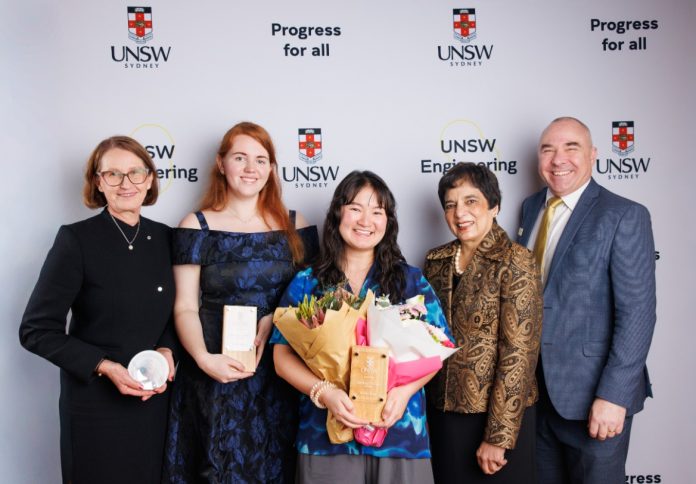
UNSW Sydney has recognised the achievements of women engineers across industry, research and academia at its 2026 Women in Engineering Alumni Awards, with engineering leader Dr Gunilla Burrowes receiving the Ada Lovelace Medal for Outstanding Engineer.
The Ada Lovelace Medal, established by UNSW Engineering in 2016, recognises engineers whose careers have made a significant impact while serving as role models for future generations.
This year’s recipient, Dr Burrowes, is Chair (NSW Division) of the Australian Academy of Technological Sciences and Engineering and has spent more than four decades working across renewable energy, deep technology, entrepreneurship and STEM diversity.
Her career has included early work on photovoltaic systems with BP Solar, co-founding engineering company BlueZone Group, research into autonomous underwater vehicle swarming, and establishing clean technology investment and innovation initiatives supporting emerging ventures.
Accepting the award, Dr Burrowes reflected on the legacy of Ada Lovelace and the responsibilities facing engineers in the age of artificial intelligence.
“It seems fitting to reflect on the fact that today we are seeing the beginning of the AI era,” she said.
“We really no longer can simply ask the question about what AI can do, but maybe consider what AI should be doing… it is the responsibility of engineers to have that wisdom, that courage to ask the questions of what AI really needs and should do for humanity now.”
The Judy Raper Award for Leadership was presented to Dr Meganne Christian, a member of the European Space Agency astronaut reserve and Senior Exploration Manager (Commercial) at the UK Space Agency. Unable to attend the ceremony, Dr Christian said in a video message that her time at UNSW had helped prepare her for an unconventional career path.
“One of the biggest lessons I have learnt is that careers rarely follow a straight line,” she said.
“What matters is staying curious, saying yes to new challenges and being willing to grow in directions you never imagined.”
Special recognition in the leadership category was awarded to Jo-Anne Dudley of Miner Ventures Pty Ltd and Turia Pitt, founder of Turia Pitt International.
The Maria Skyllas-Kazacos Young Professional Award for Outstanding Achievement was presented to Aishwarya Jha, a senior electrical engineer at Jacobs, in recognition of her work on high-voltage infrastructure and decarbonisation projects.
“This award means a great deal to me because it not only recognises the technical excellence, but also the impact people can make by delivering projects that benefit our community,” Jha said.
The selection panel also recognised Dr Jessica Yajie Jiang from UNSW’s School of Photovoltaic & Renewable Energy and Associate Professor Emma Lovell from UNSW’s School of Chemical Engineering.
The Inspiring Student Award was jointly awarded to chemical engineering student Hayley Jiang and master’s student Sarah Muller for their leadership, mentoring and contributions to engineering and STEM outreach. Additional recognition was given to current UNSW students Nickel Alofainamailelagi, Josephine Kelly and Yuka Maruyama.
Professor Julien Epps, Dean of UNSW Engineering, said the awards celebrated achievement across every stage of an engineering career.
“These awards recognise excellence across every stage of an engineering journey, from students already making a difference to established leaders whose work is shaping industries and communities,” Professor Epps said.
Professor Rita Henderson, Deputy Dean (Societal Impact and Translation) at UNSW Engineering and a member of the selection committee, said the awards highlighted the importance of inclusion within the profession.
“Equity, diversity and inclusion are essential to the future of engineering because the challenges our profession is asked to solve affect every part of society,” Professor Henderson said.
The UNSW Women in Engineering Alumni Awards form part of the university’s ongoing efforts to encourage greater participation by women, non-binary and gender-diverse people in engineering and to recognise leadership and excellence across the profession.