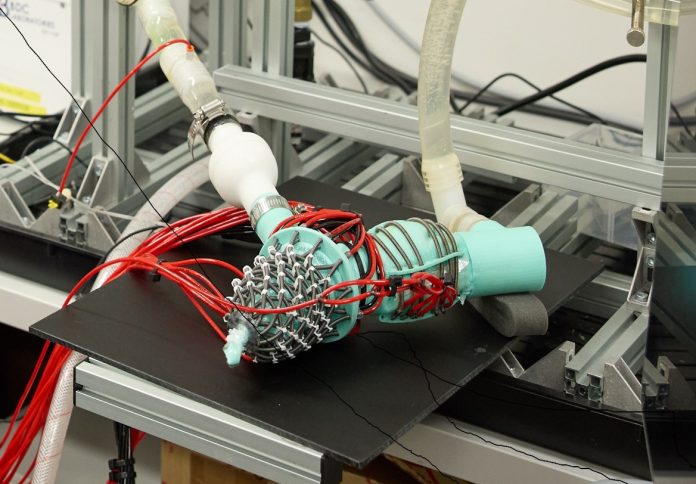
Researchers at UNSW Sydney have developed a soft robotic model of the human heart designed to replicate key aspects of heart function and disease, with the aim of supporting research into cardiovascular conditions and the development of new medical devices.
The research, published in Nature Communications and Advanced Science, describes a fully synthetic model of the left side of the heart that includes artificial valves, papillary muscles and chordae tendineae.
According to UNSW, the model can reproduce the movement of a beating heart as well as disease-related changes, including mitral valve regurgitation, where blood leaks backwards through the heart.
UNSW said the technology could eventually help researchers better understand heart disease, provide a platform for testing cardiac devices before they are used in animals or patients, and support the development of patient-specific treatment planning.
Scientia Associate Professor Thanh Nho Do, from UNSW’s School of Biomedical Engineering and UNSW Medical Robotics Lab, said cardiovascular disease remains the leading cause of death globally, making improved research tools important.
“Heart failure with preserved ejection fraction (HFpEF) is a complex heart condition that often occurs alongside other health problems such as high blood pressure, irregular heartbeats, kidney disease, obesity, and diabetes,” Do said.
“Because it affects people in different ways, developing medical devices to improve heart function is challenging.”
He added that the team’s broader goal is to create realistic artificial heart models that allow researchers to study disease and develop medical devices before they are tested in animals or introduced into clinical practice.
The soft robotic heart uses silicone membranes to form its internal chambers, while hydraulically powered artificial muscles reproduce the contraction and twisting motion of the human heart.
According to the researchers, the model also includes structures that control the mitral valve, allowing them to simulate conditions such as mitral valve prolapse and regurgitation.
Dr James Davies, a postdoctoral researcher in Do’s group, said the artificial muscle fibres were designed to mimic the layered muscle architecture of the human heart.
“We found a way to model this muscle fibre architecture using soft robotic artificial muscle fibres,” Davies said.
The researchers used ultrasound imaging together with pressure and blood flow measurements to compare the artificial heart’s performance with that of the human heart. They reported that the model reproduced pressure, flow and valve motion consistent with both healthy and diseased heart function.
Scientia Professor Nigel Lovell, Head of the School of Biomedical Engineering and Director of Tyree IHealthE, said the ultrasound images closely resembled those seen in clinical cardiac imaging.
“The ultrasound imaging also resembled human cardiac imaging owing to the biomimetic form and function of our model,” Lovell said.
The team also tested a newly developed soft robotic cardiac catheter inside the artificial heart, demonstrating its ability to navigate the beating model and detect contact with moving cardiac structures.
According to UNSW, the researchers believe the platform could help reduce reliance on animal studies during the early stages of medical device development by providing a controllable and repeatable testing environment.
The study also demonstrated that the model could reproduce several features associated with HFpEF, including impaired relaxation of the heart and changes in blood flow similar to those observed in patients.
Looking ahead, the researchers said they hope future versions of the technology could be customised using patient imaging data to assist with surgical planning and the selection of cardiac implants.
However, Do stressed that the current model remains a proof of concept and requires further validation against clinical data before it can be used in patient care.
“The most important next step is deeper validation against clinical data,” Do said.
Davies added that the model should be viewed as “an enabling platform” rather than a finished clinical tool, with future work focused on advancing patient-specific modelling, device testing and treatment planning.