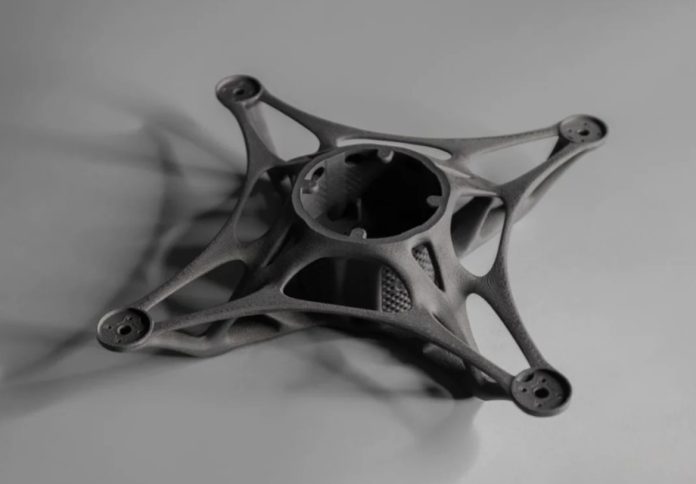
EOS has called for manufacturers seeking to meet rising demand for drones to develop resilient, scalable production systems rather than relying solely on increased output, during a recent webinar examining additive manufacturing and unmanned aerial systems (UAS).
The discussion took place during the UAS Additive Strategies webinar, hosted by 3DPrint.com and Additive Manufacturing Research (AM Research), where EOS Polymer Business Development Manager David Krzeminski outlined the manufacturing challenges facing the rapidly expanding drone sector.
According to EOS, growth in defence programs and commercial applications such as agriculture, infrastructure inspection and last-mile delivery is expected to increase demand for drone production.
Krzeminski said the industry’s focus is shifting from developing new drone designs to ensuring manufacturing systems can support larger production volumes.
He noted that some drone manufacturers are adopting principles commonly associated with automotive production, including precision, repeatability and reliability, as they seek to scale operations.
Krzeminski also challenged the idea that manufacturing scale can be achieved simply by adding more equipment. Instead, he said manufacturers must consider a range of factors including machine capabilities, materials, production workflows, quality assurance processes and supply chain capacity.
According to EOS, industrial additive manufacturing is increasingly being used beyond prototyping and product development, supporting production, spare parts manufacturing and distributed manufacturing strategies across a product’s lifecycle.
The company said additive manufacturing technologies are already being used in serial production applications across industries requiring high levels of quality and performance, including aerospace.
EOS said future growth in drone manufacturing will depend on combining additive manufacturing flexibility with industrial-scale production processes and aerospace-grade reliability.
The company argues that successful scaling will require manufacturers to integrate appropriate technologies, materials and production strategies to support consistent and repeatable output as demand increases.
The webinar also examined topics including distributed manufacturing, material innovation, supply chain resilience and the broader role of additive manufacturing in defence and commercial drone applications.