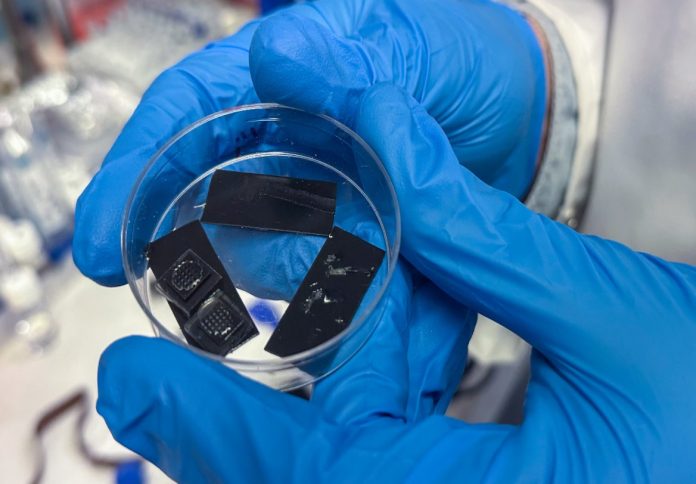
New research involving RMIT University has identified conditions that could improve the stability of dry mRNA vaccine patches, providing guidance for the future development of vaccines that are easier to store and distribute.
The study, published in the journal Advanced Functional Materials, was conducted by researchers from RMIT University, the Massachusetts Institute of Technology (MIT) and Harvard Medical School.
It examined how the lipid nanoparticles that carry mRNA respond when dried into the dissolvable material used in microneedle patches, which deliver vaccines into the skin using hundreds of tiny projections rather than traditional injections.
According to RMIT, the findings could contribute to reducing reliance on cold-chain storage, a logistical challenge that can complicate vaccine distribution. The university noted that, according to the World Health Organization and UNICEF, 14.3 million children globally received no vaccines in 2024.
Lead author Dr Brendan Dyett from RMIT said the research provides new insights into designing more stable vaccine patches.
“Many mRNA vaccines need to be stored at very low temperatures, adding cost and complexity to transport and delivery,” Dyett said.
“Our study helps explain how the particles that carry mRNA respond to drying and rehydration, which is an important step towards designing future vaccine patches that are more stable and practical to distribute.”
Researchers used advanced imaging and X-ray techniques to examine the mRNA-carrying particles before drying, during the drying process and after rehydration.
According to the study, this enabled the team to observe structural changes and identify formulation conditions that best preserved the particles’ structure and biological activity.
The researchers found that both the design of the lipid nanoparticles and the amount of polymer used in the patch material influenced how well the particles withstood drying and subsequent rehydration. They said the findings offer practical guidance for the future development of dry mRNA vaccines and therapies.
The study builds on earlier MIT-led research demonstrating that microneedle patches could be printed and stored at room temperature using a model mRNA system.
RMIT said the latest research explains why some dry patch formulations perform better than others by combining the materials characterisation expertise of RMIT with MIT’s microneedle and mRNA delivery technologies and Harvard Medical School’s virology and immunology expertise.
RMIT Distinguished Professor Calum Drummond AO said the work could support the development of more accessible mRNA-based medicines.
“This research is helping build the foundation for microneedle patches that could make advanced vaccines and therapies simpler to use and easier to access,” Drummond said.
“The long-term goal is to support technologies that are not only effective, but practical for the places and communities that need them most.”
The research team said its next steps include further optimising nanoparticle and patch formulations, evaluating immune responses and investigating whether similar approaches could be applied to other mRNA medicines.