Researchers at University of New South Wales (UNSW Sydney) have developed a new process that can convert discarded peanut shells into high-quality graphene, offering a cheaper and more sustainable pathway for advanced material production and future manufacturing applications.
In a news release, the university said the development could support more sustainable electronics and energy storage technologies by transforming agricultural waste into valuable carbon-based materials used in devices such as phones, computers, and wearable technologies.
“Graphene is famous for being one of the thinnest, strongest and most conductive materials known to science,” said Professor Guan Yeoh, who led the research team at UNSW Sydney.
“It is made up of a single layer of carbon atoms arranged in a hexagonal lattice, but is hundreds of times stronger than steel, conducts electricity and heat better than copper, and is almost completely transparent.”
According to researchers, the material is widely used in technologies including batteries, solar panels, touch screens, flexible electronics and high-speed transistors. However, conventional graphene production remains costly and energy-intensive, limiting large-scale manufacturing adoption.
“There are about 55 million tonnes of peanut crops produced globally every year, yet most of the waste from the shell is either discarded or recycled into low-value applications,” Prof Yeoh said.
“What we have shown is that basic peanut shells can be turned into high-quality graphene using much lower energy and without using chemicals, which provides environmental benefits and supports more cost-effective material production.”
The research team identified lignin, a natural polymer in plant matter rich in carbon, as the key component enabling the process.
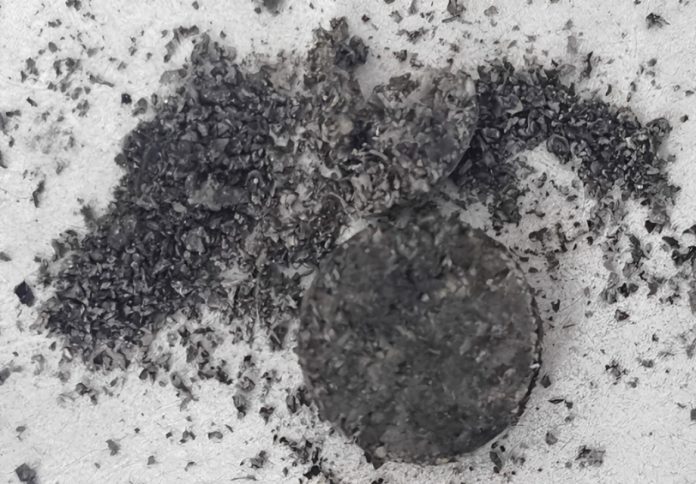
The peanut shells are first heated to about 500°C for five minutes to remove impurities and form carbon-rich char.
The char is then subjected to flash joule heating, where an electrical pulse rapidly raises the temperature to around 3000°C for just milliseconds. This extreme but brief heating rearranges carbon atoms into single-layer graphene.
Researchers noted that unlike traditional methods that rely on fossil fuel-derived carbon black, the new technique uses only peanut-shell-derived material, simplifying the production pathway while reducing chemical inputs.
The entire process can be completed in roughly 10 minutes and is estimated to require significantly less energy than many commercial graphene manufacturing techniques. Researchers calculated that producing one kilogram of graphene using the method would cost about US$1.30 in energy.
“What we identified in the experiments was that the most important aspect in producing high-quality graphene was the precursor engineering done to the peanut shells before heating,” Prof Yeoh said.
“That step is vital to remove impurities and ensure the final graphene has minimal structural defects so that it functions effectively as a single atomic layer.”
While the quantity of graphene produced so far remains limited, the team is optimistic about scaling the technology. Commercialisation could be possible within three to four years if further development is successful.
The researchers also believe the approach could extend beyond peanut shells. Other organic waste materials containing lignin, such as coffee grounds or banana peels, are being explored as potential feedstocks.
“We’ve used peanuts as a test case, but the key ingredient is lignin, which is present in many plants,” Prof Yeoh said.
“Considering how much organic material is available, our work demonstrates a good balance between energy efficiency, graphene quality and economic viability.”